Creatine Isn't Just for Bodybuilders: What the Latest Research Says
For years, creatine was associated mostly with bodybuilders, athletes, and people trying to get bigger and stronger.
That reputation is changing.
Today, creatine has become one of the most talked-about supplements for strength, exercise performance, lean muscle, and healthy aging. Researchers are also studying its potential benefits in women and older adults.
As the American Medical Association recently put it, creatine was once viewed primarily as something bodybuilders took, but people of different ages and activity levels are now using it. American Medical Association
So, what exactly is creatine, and why is it getting so much attention?
What Is Creatine?
Creatine is a naturally occurring compound that plays an important role in your body's energy system.
Your body makes creatine on its own, and you can also get it through foods, particularly meat and fish. According to the American Society on Aging, the body produces approximately 1 gram of creatine per day, while a typical non-vegetarian diet may provide another 1 to 2 grams. ASA Generations
Most of the creatine in your body is stored in skeletal muscle, where it helps support the rapid production of energy during demanding activities.
That is one reason creatine has been studied so extensively in connection with resistance training, strength, power, and muscle.
But its usefulness may extend beyond competitive athletes.
Creatine Can Help Support Strength and Muscle
This remains one of the strongest reasons people use creatine.
Creatine can help increase the availability of rapid energy in your muscles, which may allow you to perform more work during resistance training.
Over time, better training capacity combined with consistent resistance exercise can contribute to increases in strength and lean muscle.
Dr. Jason Mitchell explained it this way to the American Medical Association:
"When you take creatine monohydrate in conjunction with strength training, you actually do build additional strength." American Medical Association
The important part is "in conjunction with strength training."
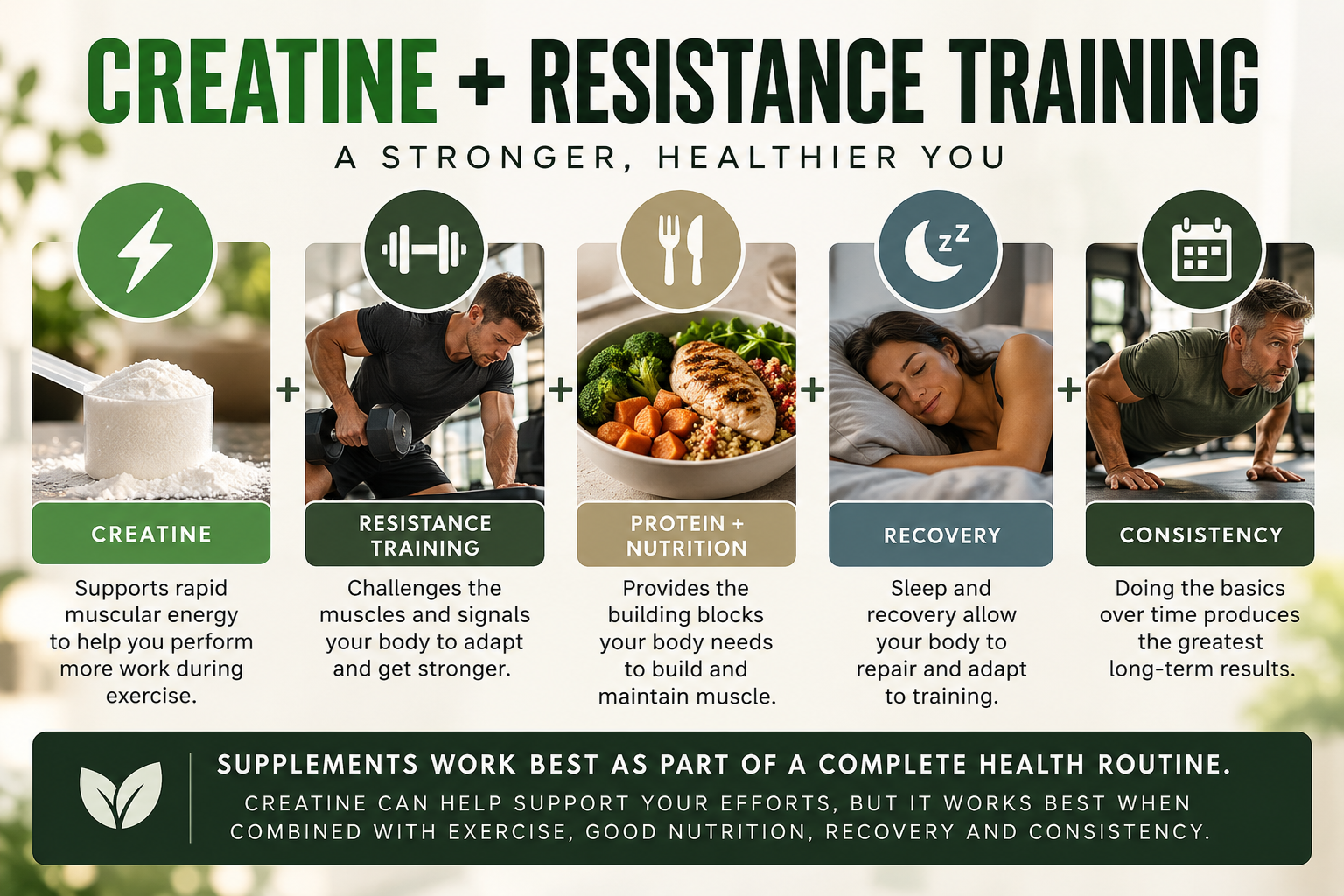
Creatine isn't a replacement for exercise, adequate protein, good nutrition, sleep, or consistency. Instead, it can be one tool that complements those fundamentals.
What About Creatine as You Get Older?
This may be one of the most interesting developments in creatine research.
Maintaining muscle becomes increasingly important as we age.
A recent Texas A&M study examined healthy adults between 45 and 65 years old. Over 12 weeks, adults taking creatine who were not participating in the structured exercise program gained about 2.4 pounds of lean tissue and improved leg and bench-press strength. Participants who combined creatine with the exercise program experienced additional improvements in several strength and performance measures. Texas A&M Stories
The researchers summarized the broader significance simply:
"Creatine supplementation could help older adults boost lean mass and strength." Texas A&M Stories
That matters because muscle isn't just about appearance.
Muscle helps us move, lift, climb stairs, maintain balance, remain active, and continue doing the things we enjoy as we get older.
The AMA also highlighted this connection between muscle and aging. Dr. Mitchell explained that maintaining muscle as we age can help preserve mobility and our ability to live independently. American Medical Association
This is where the conversation around creatine has changed significantly.
It's no longer just about building bigger muscles. It's also about maintaining the muscle you have.
Creatine for Women
Creatine is also getting significantly more attention among women.
A 2026 systematic review and meta-analysis examined seven randomized controlled trials involving 608 postmenopausal women.
Researchers found that creatine supplementation favored modest improvements in lean mass and leg-press strength. The benefits were particularly evident in studies combining at least 5 grams of creatine per day with resistance training. Effects on bone density, however, remained unclear. PubMed
The researchers concluded that creatine combined with resistance training produced "small but meaningful gains in lean mass and strength" among postmenopausal women. PubMed
That's another reason the stereotype of creatine as a "men's bodybuilding supplement" is becoming outdated.
Women who want to remain strong and maintain lean muscle may also have good reason to pay attention to creatine.

"But I Don't Want Creatine to Make Me Gain Weight"
This is one of the biggest concerns people have about creatine, particularly people who are actively trying to lose weight.
And it's important to understand what the number on the scale actually represents.
Creatine can cause an initial increase in body weight, in part because increased creatine storage in muscle is accompanied by water.
That does not mean you've suddenly gained body fat.
The AMA specifically warns people not to become discouraged if the scale goes up after beginning creatine, noting that the increase can include water weight and muscle weight. American Medical Association
And that brings us to something even more important:
The goal shouldn't always be to weigh less. The goal should be to improve body composition and health.
Imagine two people who both weigh 180 pounds.
One has more body fat and less muscle.
The other has more lean muscle and less body fat.
The scale says they're the same. Their body composition says something very different.
This is why preserving lean muscle is so important, especially when losing weight.
When you lose weight, you don't necessarily want to simply lose as many pounds as possible. Ideally, you want to reduce excess body fat while preserving as much lean tissue as possible.
The recent Texas A&M study is particularly interesting here. Participants following the exercise and calorie-restricted diet who took creatine gained nearly three pounds of lean tissue while reducing fat mass over the 12-week intervention. Texas A&M Stories
That doesn't mean creatine is a fat-loss supplement. It isn't.
In fact, the AMA explicitly notes that creatine by itself does not cause fat loss. American Medical Association
But if your goal is improving your body composition, lean muscle is something you generally want to preserve, not fear.
So don't judge progress by the scale alone.
Pay attention to strength, measurements, body composition, how your clothes fit, how you feel, and what your body can do.
Creatine Monohydrate: The Form With the Research Behind It
Walk into a supplement store and you'll see several different forms of creatine.
But most of the research has focused on one:
Creatine Monohydrate
Dr. Mitchell told the AMA:
"You have to look for creatine monohydrate." American Medical Association
His reasoning is straightforward: other forms of creatine simply don't have the same depth of research behind them.
You don't necessarily need a complicated creatine formula.
Sometimes simple is better.
Is Creatine Safe?
Creatine is one of the most extensively researched nutritional supplements available.
The recent Texas A&M article points to a 2025 analysis of 685 clinical trials that found no significant difference in reported side-effect rates between people taking creatine and those receiving a placebo. Texas A&M Stories
The AMA similarly describes creatine as well studied, while noting that some people may experience gastrointestinal discomfort, nausea, or weight gain. American Medical Association
For healthy individuals, research has generally not shown evidence that recommended creatine supplementation damages healthy kidneys. However, people with kidney disease or other medical conditions should speak with their healthcare professional before using creatine or other supplements.
Creatine Is Only One Piece of the Puzzle
Creatine deserves the attention it's getting.
But no supplement replaces the basics.
For long-term strength and health, focus on:
Resistance Training
Challenge your muscles consistently.
Protein and Whole Foods
Give your body the nutrients it needs.
Recovery
Sleep and recovery are part of progress.
Consistency
What you do repeatedly matters more than what you do occasionally.
Smart Supplementation
Use supplements to complement a strong foundation, not replace one.
Creatine can fit naturally into that approach.
The Bottom Line
Creatine isn't just for bodybuilders.
Research continues to support its role in exercise performance, strength, and lean muscle, while newer research is exploring how those benefits may be particularly useful for women, middle-aged adults, and older adults.
And if you're worried about gaining weight from creatine, remember:
A higher number on the scale doesn't automatically mean you've gained body fat.
Some initial weight gain may come from increased water associated with muscle creatine storage, and over time, gaining or preserving lean muscle can be a positive outcome.
The goal isn't simply to weigh less. It's to build a body that stays strong, capable, and healthy.
Ready to Add Creatine to Your Routine?
Beyond Health Creatine provides a straightforward way to incorporate creatine into your nutrition and training routine.
Fuel Your Life.
Beyond Health